
Table of Contents
- Did I Ruin My Stainless Steel Pan?
- 1. How to Clean Burnt Food From a Stainless Steel Pan
- 2. How to Clean Burnt Sugar From a Stainless Steel Pan
- 3. How to Remove Burnt Oil From a Stainless Steel Pan
- 4. How to Clean Burnt Oil From the Outside and Bottom of a Stainless Steel Pan
- 5. How to Remove Heat Discoloration From a Stainless Steel Pan
There’s nothing quite as frustrating as seeing nasty, black burnt oil stubbornly stuck to your beautiful stainless steel pan. It looks permanent, feels impossible to scrub away, and immediately sparks that horrible thought: “Have I ruined it?” Especially when the pan was expensive, those ugly stains can be genuinely alarming.
Did I Ruin My Stainless Steel Pan?
The good news is that cleaning a burnt stainless steel pan can be surprisingly easy—or quite a battle—depending on what actually burned. Light food residue may come off after a simple soak in hot, soapy water. Burnt sauces, meat, or sugary foods can require more scrubbing, while overheated oil can be much more stubborn.
Olive oil, for example, can form a hard, brown or black layer when it is heated too strongly or left on the pan for too long. Instead of behaving like ordinary grease that simply washes away, the oil can become a tough, sticky film that clings to the steel. If that layer has been repeatedly heated, ordinary dish soap and a sponge may barely touch it.
Fortunately, even a pan that looks badly burned is often completely recoverable. Stainless steel is remarkably durable, and those frightening black and brown marks usually mean you have a difficult cleaning job ahead—not that your expensive pan is ready for the trash.
1. How to Clean Burnt Food From a Stainless Steel Pan
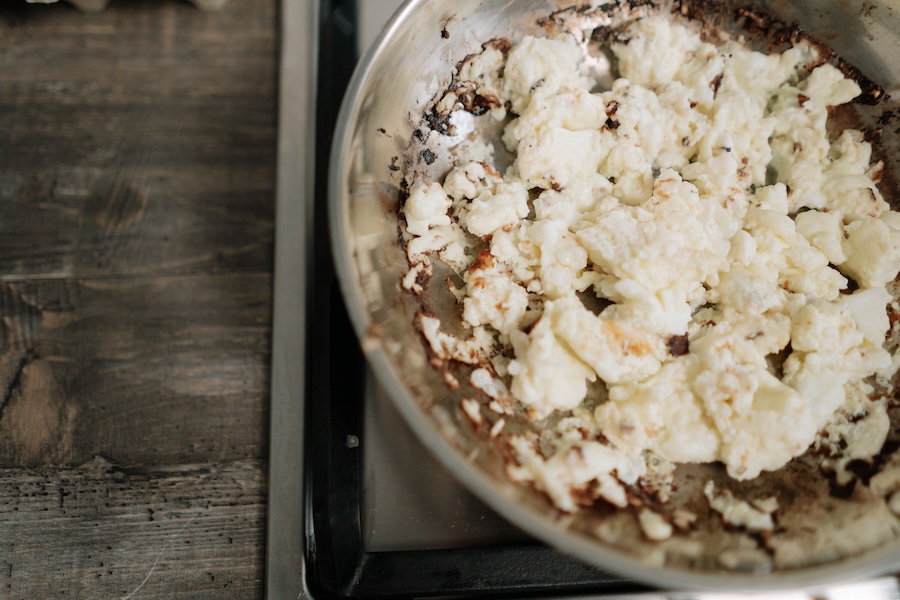
Burnt food is probably the most common—and fortunately one of the easier—problems you’ll encounter with a stainless steel pan. Meat, eggs, vegetables, pasta, or sauces can stick to the surface and eventually turn into a dark brown or black crust if the pan gets too hot or is left unattended.
How difficult it is to remove depends mostly on how badly the food has burned. A light layer may need little more than soaking, while a thick, blackened crust benefits from boiling water and baking soda.
For light burnt food:
- Fill the pan with enough hot water to cover the affected area.
- Add some dish soap and let the pan soak for 15–30 minutes.
- Scrub the loosened residue with a non-scratch sponge.
- Rinse and inspect the pan. Repeat if necessary.
For heavily burnt food:
- Fill the pan with enough water to completely cover the burnt area.
- Add one or two tablespoons of baking soda.
- Bring the water to a gentle boil and let it simmer for about 5–10 minutes.
- While the residue is softening, gently loosen it with a wooden or silicone spatula.
- Turn off the heat and allow the pan to cool.
- Pour out the dirty water and wash the pan with dish soap and a non-scratch sponge.
- If dark spots remain, make a paste from baking soda and a small amount of water, apply it to the stains, and gently scrub again.
- Rinse thoroughly and dry the pan.
The important thing is not to panic and aggressively scrape the pan while it is dry. Stainless steel can tolerate plenty of cleaning, but knives, metal scrapers, steel wool, and very coarse abrasives can leave permanent scratches. Burnt food usually looks much worse than it actually is, and in most cases the pan can be brought back to normal without damaging the steel.
2. How to Clean Burnt Sugar From a Stainless Steel Pan
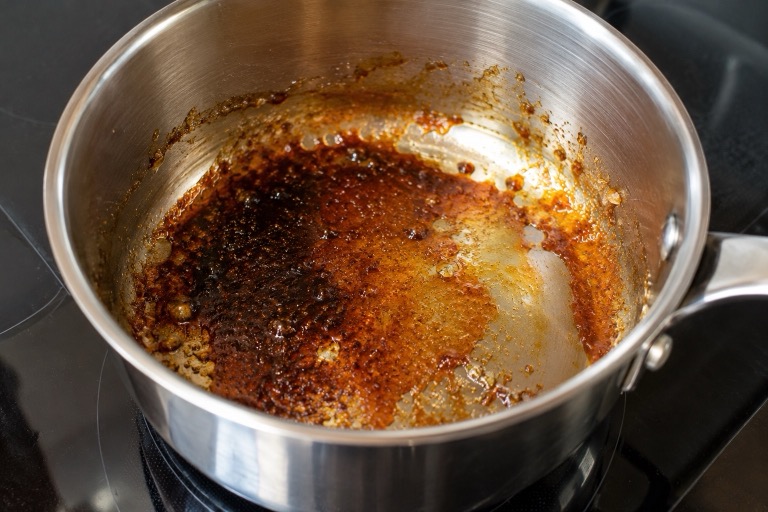
Burnt sugar can look intimidating because it quickly turns into a hard, dark crust that seems almost fused to the pan. Caramel, honey, syrups, barbecue sauce, sweet marinades, and other sugar-heavy foods can all create this problem.
Fortunately, burnt sugar is often easier to remove than burnt oil because sugar dissolves in water. The biggest mistake is trying to chip or scrape the hardened sugar off while the pan is dry. Water and heat can do most of the work for you.
How to clean burnt sugar from a stainless steel pan:
- Let the pan cool enough to handle safely.
- Fill it with enough hot water to completely cover the burnt area.
- Let it soak for 20–30 minutes.
- If the residue remains hard, place the pan on the stove and bring the water to a gentle simmer.
- Simmer for about 5–10 minutes.
- Gently loosen the softened residue with a wooden or silicone spatula.
- Allow the pan to cool sufficiently and pour out the water.
- Wash the pan normally with dish soap and a non-scratch sponge.
- If necessary, repeat the process or use a baking soda paste on the remaining spots.
For an exceptionally thick or blackened layer, add one or two tablespoons of baking soda to the water before simmering.
Avoid attacking hardened caramel with a knife or metal scraper. Although it may feel like you need brute force, dissolving and softening the sugar is usually far more effective and carries much less risk of scratching the stainless steel.
3. How to Remove Burnt Oil From a Stainless Steel Pan
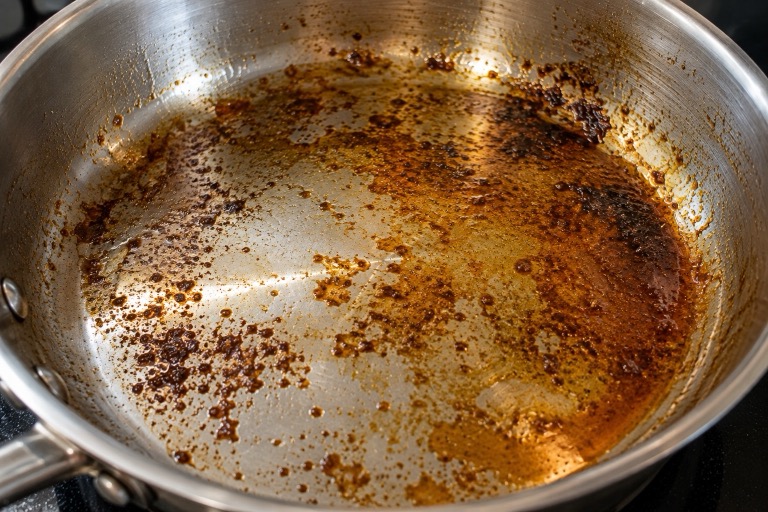
This is where cleaning a stainless steel pan can become considerably more difficult. Olive oil, sunflower oil, rapeseed oil, and other cooking fats can leave yellow, brown, or eventually black deposits when they are overheated.
The particularly stubborn problem is polymerized oil. Under prolonged or repeated heating, oil can chemically change and form a hard coating that bonds strongly to the surface. At this point, simply soaking the pan in dish soap may accomplish very little.
A thin, fresh oil stain can often be removed with baking soda. An old, dark layer that has been heated repeatedly may require several cleaning attempts or a dedicated stainless steel cleaner.
For light to moderate burnt oil:
- Wash away any loose grease with hot water and dish soap.
- Sprinkle baking soda generously over the stained area.
- Add a small amount of water to create a thick paste.
- Leave the paste on the stain for 15–30 minutes.
- Scrub firmly with a non-scratch sponge.
- Rinse the pan and repeat if necessary.
For stubborn polymerized oil:
- Cover the affected area with water.
- Add one or two tablespoons of baking soda.
- Bring the water to a gentle boil and simmer for approximately 10 minutes.
- Allow the pan to cool enough to handle safely.
- Pour out the water and scrub the softened deposits.
- If a hard brown or black film remains, apply a stainless steel cleaner suitable for cookware according to its instructions.
- Scrub with a non-scratch sponge.
- Wash the pan thoroughly with dish soap and plenty of water before using it for food again.
This is also where patience matters. A badly polymerized layer may not disappear in one cleaning session. Two or three controlled cleaning attempts are better than immediately reaching for something extremely abrasive and permanently scratching the pan.
4. How to Clean Burnt Oil From the Outside and Bottom of a Stainless Steel Pan
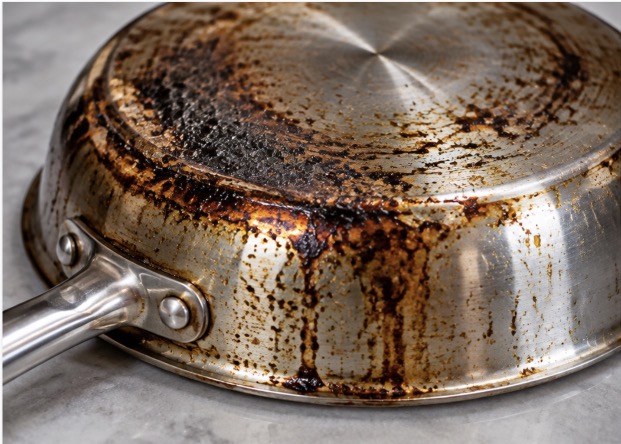
Sometimes the cooking surface is perfectly fine while the outside of the pan looks terrible. Oil can splash over the sides, drip underneath the pan, or collect around the rim. Every time the pan goes back onto the stove, those residues are heated again.
Over time, they can develop into a dark brown or black coating similar to polymerized oil. The bottom can become particularly dirty because it receives direct heat.
The advantage is that you can usually clean the exterior more aggressively because you are not dealing with the main food-contact surface.
How to clean burnt buildup from the outside of a stainless steel pan:
- Wash the exterior with hot water and dish soap to remove loose grease.
- Make a thick paste from baking soda and a small amount of water.
- Spread it over the burnt exterior areas.
- Leave it for approximately 20–30 minutes.
- Scrub firmly with a non-scratch scouring pad or sponge.
- Rinse and inspect the surface.
- Repeat the treatment if significant buildup remains.
- For extremely stubborn deposits, use a cleaner specifically labeled as suitable for stainless steel, following the manufacturer’s directions.
- Wash and rinse the entire pan thoroughly afterward.
Pay attention to the pan’s construction and finish. A brushed or polished exterior can show scratches much more easily than you might expect, so test stronger abrasives on an inconspicuous area first.
5. How to Remove Heat Discoloration From a Stainless Steel Pan
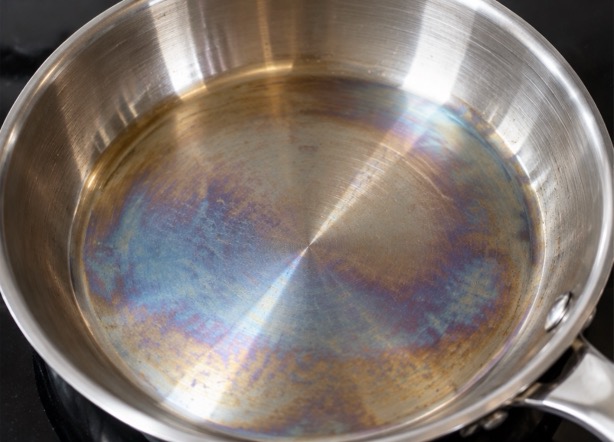
Not every strange mark on stainless steel is burnt food or oil. If your clean pan develops blue, purple, golden, bronze, or rainbow-colored patches after cooking, you may simply be looking at heat discoloration.
Heating stainless steel can change the thickness of the extremely thin oxide layer on its surface. Light reflecting through that layer produces the different colors. It may look alarming, particularly on a new and expensive pan, but it does not necessarily mean anything has burned onto the steel.
This is also why scrubbing harder and harder may seem to accomplish nothing: there may be no physical layer of burnt material to scrub away.
How to remove heat discoloration from stainless steel:
- Allow the pan to cool completely.
- Wash it normally to make sure there is no grease or food residue present.
- Add a small amount of white vinegar to the affected surface.
- Gently wipe the discolored area with a soft sponge or cloth.
- Let the vinegar remain in contact with the surface briefly if necessary.
- Rinse thoroughly with clean water.
- Dry the pan immediately with a clean towel.
- Repeat once if some discoloration remains.
A stainless steel cleaner designed for cookware can also help with persistent discoloration.
Most importantly, heat discoloration is primarily a cosmetic problem. A rainbow-colored stainless steel pan is very different from a pan covered in a thick layer of black, carbonized oil. Identifying which problem you actually have can save you a great deal of unnecessary scrubbing.